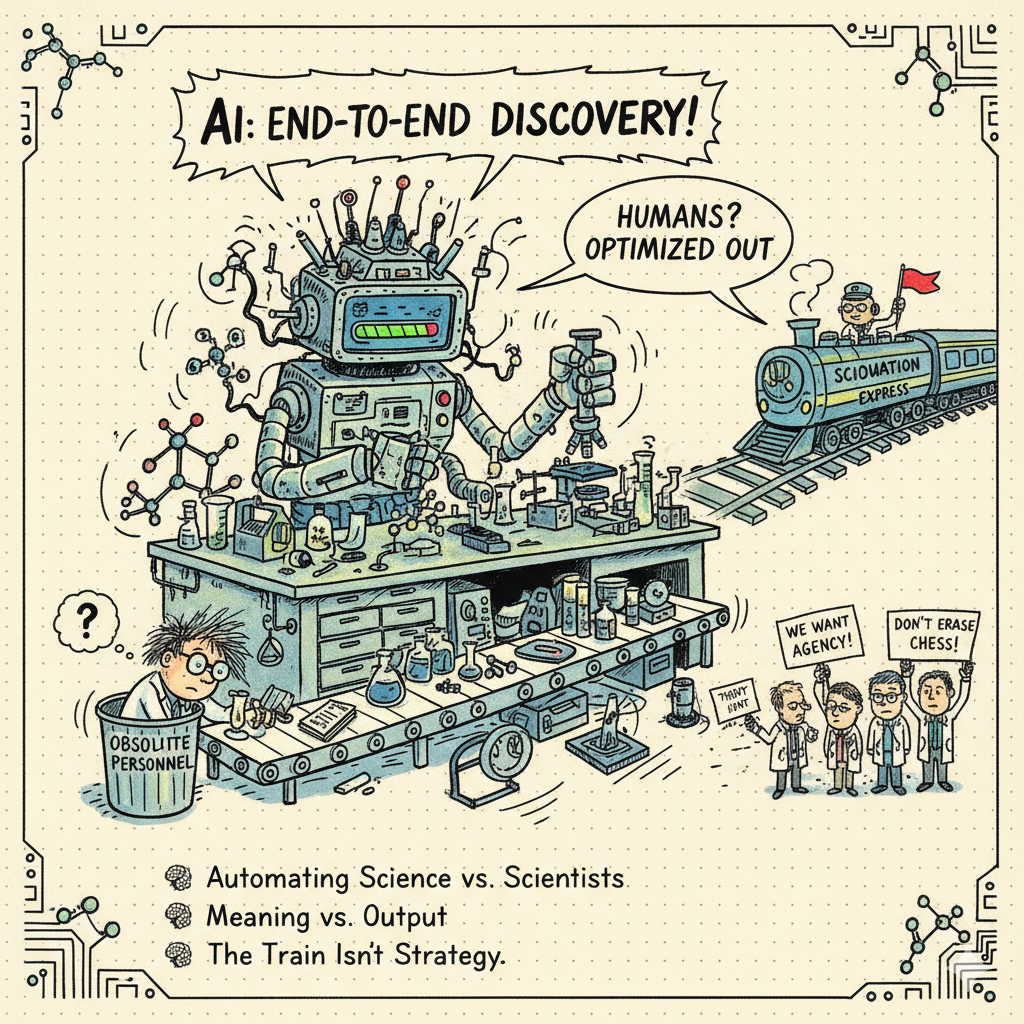
I just read a thought‑provoking piece by Julian Togelius arguing against “strong science automation” – the idea that we might eventually remove humans entirely from the scientific loop and let AI do all the “real” science.
As someone who lives at the intersection of molecular simulation, VR, HPC and AI, I feel this tension every day: we build ever‑smarter tools, but we rarely stop to ask what kind of scientific culture we are engineering at the same time.
A few ideas that resonated with me – and that I think our community urgently needs to discuss.
1. Automating science vs. automating scientists
I love tools that make us better: faster MD runs, smarter sampling, auto‑analysis pipelines, LLMs that help draft code or protocols. That’s “weak science automation”: humans firmly in the driver’s seat, tools on the dashboard.
What worries me is the implicit ambition some people now say out loud: “end‑to‑end” automated discovery, where humans become spectators. At that point we’re not just automating tasks – we’re automating away a core source of meaning for researchers.
If you’ve ever watched a student’s eyes light up when they really understand a mechanism, you know that’s not a line of code you can simply delete from the system.
2. Science as a source of meaning, not just output
I work with molecules, GPUs and headsets, but my real job is something softer: helping people find meaning in doing good science.
If an AI can propose better ligands or materials than I can – fine, I’ll take the help. But if the logical conclusion of our trajectory is that the next generation has no meaningful way to contribute, then we have “optimised” for the wrong objective function.
We are not just maximising citations, patents, or “time‑to‑cure‑cancer”. We are also (whether we admit it or not) optimising for a world where humans still have agency, curiosity and responsibility in the process.
3. “The train is coming” is not a strategy
You know the argument: “Science automation is inevitable. Either you get on the train or you get run over.”
This is intellectually lazy. Technology isn’t a force of nature; it’s a series of design and funding choices. We decide what to build, deploy, regulate and reward.
In my world of HPC and molecular modelling, we make such choices all the time: Which problems are worth thousands of GPU‑hours? Which results get turned into software libraries and shared? We could decide that AI for science is funded and evaluated primarily when it augments human capability instead of replacing it.
That requires courage, not resignation.
4. The chess analogy misses the point
The panel apparently suggested that even if AI does all “real” science, humans could still “play science” as a hobby, just like people play chess despite engines being stronger.
The analogy fails for me.
Chess is a game. Science is a joint, intergenerational project to understand reality and improve the human condition. Doing it “as a hobby” while the serious work is outsourced to opaque systems is not the same thing.
In my field, this would mean people “playing” with toy simulations while some giant closed model designs real drugs, materials and processes. That’s not a culture of science; that’s a content‑farm for curiosity.
5. What I do want from AI in science
Despite this critique, I’m very optimistic about AI for science – when used with intention. In computational chemistry, visualisation and VR, there is huge potential in AI tools that:
- Reduce cognitive load (better interfaces, better defaults, better explanations).
- Surface non‑obvious hypotheses while letting humans choose what matters.
- Help us navigate complex literatures and enormous simulation datasets.
- Make advanced methods accessible to more labs, not fewer.
- Support healthier working cultures (less drudgery, more sleep, more deep thinking).
In other words: AI as an amplifier of human insight and wellbeing, not as a replacement for it.
Personal note: I’ve spent decades trying to make complex molecular worlds more graspable for humans – from high‑performance simulations to immersive VR. The day we decide that humans no longer need to grasp anything, only to consume results, is the day my whole career stops making sense.
I’m not willing to optimise my tools for that future.
So I’m curious: in your corner of research – whether you run wet labs, simulations or policy – where would you draw the line between “AI that empowers me” and “AI that slowly makes my role meaningless”?
Inspired by the post "Please, don't automate science!" by Julian Togelius.